New Jersey Is Holding PFAS Polluters Accountable. North Carolina Is Still Marinating Its Pigs in PFAS.
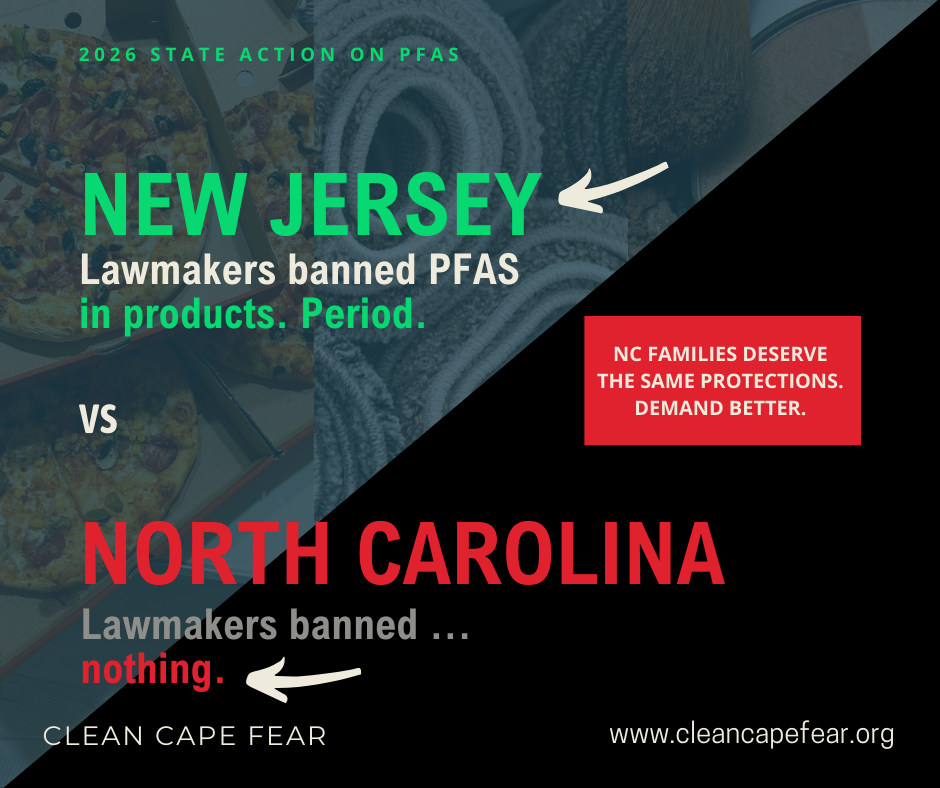
Recently we shared a post about New Jersey's newly signed "Protecting Against Forever Chemicals Act" which bans PFAS from cosmetics, carpets, food packaging, and fabric treatments starting in 2028. The bill also requires labeling on PFAS-containing cookware, and funds a source reduction program and research/monitoring. North Carolina lawmakers have banned…nothing.
Look, North Carolina, we need to talk. We pride ourselves on our BBQ. Eastern style. Western style. The great vinegar-vs-tomato debate that has divided neighbors long before social media algorithms. In NC, we love our pigs–so much so we are home to one of the largest slaughterhouses in the world. Yes, the world.
But here's the thing: our pigs are probably swimming in PFAS-contaminated water. The Cape Fear River provides drinking water to 1.5 million North Carolinians but has been used as a PFAS sacrifice zone since 1980. Those chemicals are in our fish. Our soil. Our air. Our backyard gardens. Our kids' blood. And while New Jersey has been out there actually doing something about it, North Carolina has been busy holding research grant ceremonies and accepting a different kind of pork (aka donations) from the polluter-friendly NC Chamber of Commerce.
So we're keeping score. Consider this your PFAS accountability scoreboard. NJ vs. NC. Updated in real time. Spoiler: it's not close. And yes, we're tracking it in contaminated pigs. 🐷
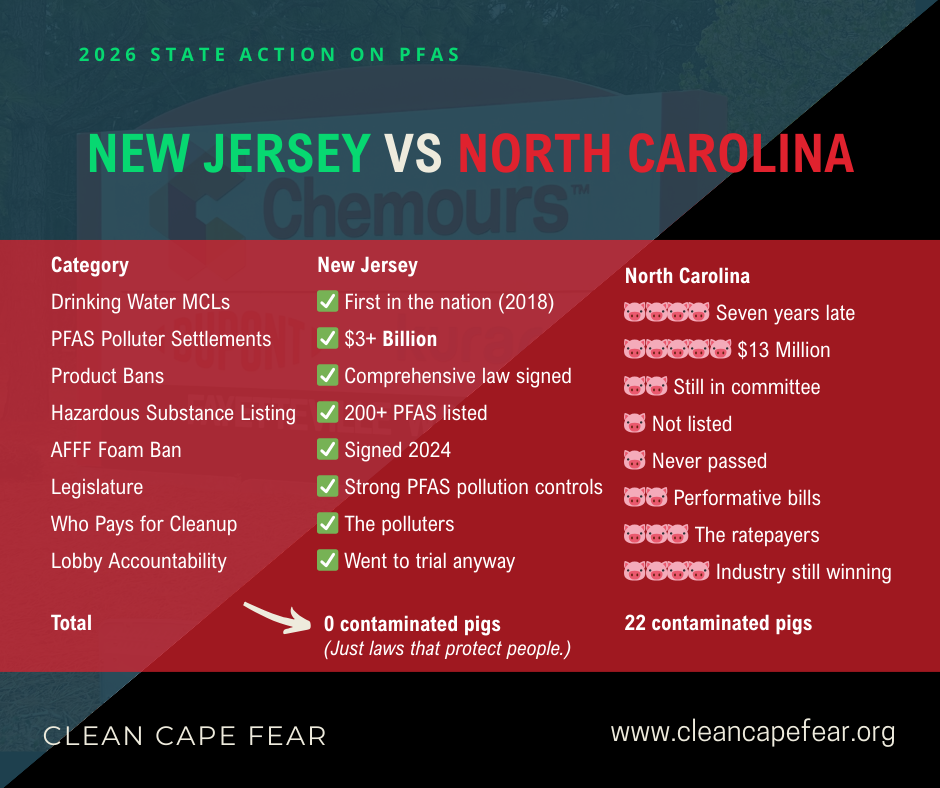
THE SCOREBOARD: NJ vs. NC ON PFAS
(Updated through early 2026. Pigs = PFAS contaminated pigs. The more pigs NC earns, the worse we're doing.)
ROUND 1: Drinking Water Standards
New Jersey:
Set the first enforceable drinking water standard for any PFAS compound in the entire country back in 2018 — a legally binding limit for PFNA at 13 parts per trillion. By 2020 they had added limits for PFOA and PFOS too. No waiting for the feds. No "let's study it more." Just: here is the legal limit, utilities must comply, end of discussion.
North Carolina:
Had a health advisory for GenX at 140 parts per trillion. A health advisory is not a law. It is the regulatory equivalent of a sticky note on the fridge that says "maybe don't drink too much of this." It is not enforceable. Nobody goes to jail. Nobody pays a fine. The contamination just...continues.
NC finally adopted groundwater ONLY standards for three PFAS (PFOA, PFOS, and GenX) in November 2025. Seven years after New Jersey. NC has a very dysfunctional environmental rulemaking process called the Environmental Management Commission (EMC). Historically, the EMC has served as an excuse for NCDEQ to be hamstrung by both political parties. Now, the EMC has become overly politicized beyond repair and severely captured by the chemical industry. Nobody wins but the chemical industry.
NC SCORE: 4 Contaminated Pigs 🐷🐷🐷🐷 (One for each PFAS compound NC took seven years longer than NJ to regulate and one for the corrupt and useless EMC.)
ROUND 2: The Settlements (aka Who Made the Polluters Pay)
This is where it really hurts, y'all.
DuPont and Chemours have facilities in both states. Same company. Similar chemicals. Same 40+ years of knowingly poisoning people while hiding the evidence. New Jersey has DuPont/Chemours Chamber Works in Salem County and Solvay in Gloucester County. North Carolina has DuPont/Chemours Fayetteville Works in Bladen County.
Here is what each state recovered:
New Jersey:
💰 $2 billion DuPont, Chemours & Corteva (2025)--the largest single-state environmental settlement in U.S. history.
💰 $450 million from 3M settlement (2025)
💰 $392.7 million from Solvay settlement (2023)
💰 $109 million from Arkema settlement (2023)
TOTAL: More than $3 BILLION recovered from polluters
North Carolina:
💰 $13 million from Chemours settlement (2019)--one of the speediest settlements ever.
TOTAL: $13 million
To be crystal clear about what that means: the Cape Fear Public Utility Authority spent $43 million just to install filters at ONE water treatment plant to remove the PFAS Chemours put in the river. NC got less from Chemours than it cost one utility to clean up Chemours' mess.
New Jersey got $3 billion. North Carolina got less than one-third of what it cost Wilmington to filter its water.
Worth noting: NJ public utilities also filed their own lawsuits against PFAS manufacturers, including Chemours, just like CFPUA and Brunswick County Public Utilities did here. But there's a critical structural difference. NJ utilities had a legal hook: the state had already set enforceable MCLs, which created a clear, court-ready basis to sue for the cost of compliance. And crucially, the NJ Attorney General was simultaneously fighting its own massive state-level lawsuits against the same companies, meaning utilities weren't carrying the fight alone. The state fought alongside them. In North Carolina, utilities in southeastern NC are shouldering the legal battle largely by themselves, without meaningful state enforcement behind them, and when the state did sue it only walked away with $13 million against a cleanup bill that is expected to exceed $500 million in public water upgrades alone across the region.
Also, also worth noting: NC’s Attorney General is still in active litigation with Chemours, DuPont and Corteva for natural resource damages associated with Fayetteville Works.
NC SCORE: +5 Contaminated Pigs 🐷🐷🐷🐷🐷 (That's a whole pig pickin' worth of accountability failure)
ROUND 3: PFAS Product Bans
New Jersey:
Passed the "Protecting Against Forever Chemicals Act" (the one we posted about recently) which bans PFAS in:
✅ Cosmetics
✅ Carpets
✅ Food packaging
✅ Fabric treatments
✅ Cookware (with required labeling)
Plus it funds PFAS research and monitoring. Effective 2028. Signed, sealed, delivered.
North Carolina: [loading... loading... still loading...]
Nothing. No product bans. No labeling requirements. No funded monitoring program.
PFAS product ban laws have been introduced in NC like House Bill 881, introduced in 2025 by Rep. Deb Butler (D-New Hanover), Rep. Pricey Harrison (D-Guiliford), and others. This bill wanted to ban non-essential PFAS uses statewide and fund nearly $600,000 in health studies. It was sent to the Rules Committee–where bills go to die. It was never brought to a vote in the House or crossover to the Senate this legislative session. We imagine the Chamber quietly opposed it. Again.
We have a feeling the NC Chamber would probably say banning PFAS in lipstick would destroy the state economy because apparently everything destroys the state economy. They’ve said similar things before.
Here’s the thing, California has banned or restricted 900+ toxic chemicals including PFAS in clothing, cookware, and cosmetics; yet, somehow manages to be the 4th largest economy on the entire planet. Not among US states. The planet. The "regulation kills business" argument doesn't just have a California problem, it has a $4.3 trillion state GDP problem. When companies threaten to leave because they can't put toxic forever chemicals in your leggings and blankies, maybe the right answer is: bye.
NC SCORE: +2 Contaminated Pigs 🐷🐷 (Two pigs, one for cosmetics and one for food packaging — because yes, the packaging your NC BBQ comes in might have PFAS in it. We wish we were joking.)
ROUND 4: Hazardous Substance Listings (aka Legal Ammo)
New Jersey:
Built something NC hasn't yet—a state law that automatically converts federal chemical listings into enforcement power. Under NJ's Spill Compensation and Control Act, when the EPA adds PFAS to its Toxic Release Inventory (TRI), which it's required to do on a rolling basis under the 2020 National Defense Authorization Act, those chemicals are automatically incorporated into NJ's Appendix A hazardous substances list. As of June 2025, that list covers over 200 PFAS compounds. The moment a chemical lands on the federal TRI list, New Jersey can sue polluters for cleanup costs, access its Spill Compensation Fund, and hold industrial facilities strictly liable for any discharge. No separate state rulemaking. No waiting. No EMC vote. That legal architecture is a big part of why billion-dollar settlements are possible in NJ.
North Carolina:
Has no equivalent mechanism. NC has no state Spill Act and while NC has cleanup funds, they're underfunded, appropriation-dependent, and structurally incapable of addressing PFAS because PFAS isn't defined as a hazardous substance under NC law. And unlike NJ, which uses its legal architecture to go beyond federal standards, NC has consistently done the minimum of adopting federal rules only when required, and even then, industry-aligned appointees on the EMC have worked to slow or block NCDEQ's own proposed PFAS rules for surface water and groundwater. The legal ammo just isn't there in NC.
NC SCORE: +1 Contaminated Pig 🐷 (One very legally disarmed pig)
ROUND 5: Firefighting Foam Ban
AFFF (aqueous film-forming foam) is one of the major sources of PFAS contamination at military bases and airports across both states. Banning its use stops new contamination.
New Jersey:
Banned PFAS firefighting foam statewide. Governor Murphy signed it in January 2024. Done.
North Carolina:
Has introduced a similar ban... multiple times. It keeps dying in committee. Firefighters in our state are still potentially being exposed to PFAS through their own gear while legislators debate whether to do anything about it. Rep. Mike Clampitt (R-Jackson, Swain, Transylvania), a retired Charlotte firefighter with 30+ years of service, has been a primary sponsor on multiple versions of the bill. That doesn’t seem to matter in NC because no AFFF bans have ever passed.
NC SCORE: +1 Contaminated Pig 🐷(One truly smoked pig, cooked in PFAS foam)
ROUND 6: The Legislature (Pay Attention Unaffiliated Voters!)
New Jersey:
NJ’s state legislature has been Democratic-controlled for over 20 years and PFAS bills are bipartisan. They don't get performative committee hearings and quiet deaths. The AFFF foam ban passed both chambers unanimously and was signed into law in January 2024. The comprehensive "Protecting Against Forever Chemicals Act," which bans PFAS in cosmetics, carpets, food packaging and more, passed the Assembly 58-2 in December 2025.
In NC, the NC Chamber of Commerce brags about killing PFAS bills. In NJ, lawmakers are voting 58-2 to protect people from PFAS.
North Carolina:
NC’s state legislature has been Republican-controlled since 2010. A 2023 report from Duke University, conducted in partnership with Clean Cape Fear, analyzed every PFAS bill introduced in the NC General Assembly from 2021 through 2023. Here is what they found:
PFAS Performative Bills: Of 25 Republican legislators who sponsored any PFAS bill, only 3 sponsored anything related to MCLs or polluter accountability. The other 22 sponsored bills were about firefighter foam replacement and research grants which the Duke team called "performative bills." Bills that look like action but don't actually set limits on PFAS in our water or make polluters pay for what they've done.
The Duke report described the pattern plainly: North Carolina has used research grants and foam buyback programs to create the appearance of PFAS action while redirecting attention away from the regulatory measures that would actually protect public health.
Lack of Real Leadership: Rep. Ted Davis (R-New Hanover), Rep. Frank Iler (R-Brunswick), and Sen. Michael Lee (R-New Hanover) are all from southeastern NC, ground zero for the discovery of GenX in public tap water. Their constituents were the ones with bottled water stacked in PTO/PTA closets, reverse osmosis units bolted under kitchen sinks, and dangerous levels of PFAS in their blood. Proximity to poisoned water is a powerful motivator. Unfortunately, it is not powerful enough to get these guys to convince their colleagues to pass PFAS MCLs, polluter pays, or product ban bills. In the same 2023 session where Rep. Davis's polluter pay bill died in committee without a vote, the NC House voted 114-0 to officially designate the Fayetteville Dogwood Festival as North Carolina's state dogwood festival. Every single member found their voice for that one. God Bless the Dogwoods.
Dying In Rules Committee: Democrats have introduced meaningful PFAS bills session after session: MCL standards, polluter liability, source water protections. Rep. Pricey Harrison (D-Guilford) has called PFAS the biggest frustration of her 16-year legislative career. Rep. Deb Butler (D-New Hanover) keeps filing ““bill after bill” to hold Chemours accountable, but none have stuck.” PFAS health study funding bills. Product bans. None of it ever reached a floor vote. The bills land in the Rules Committee, which Republican leadership controls, and they simply never come back out.
Gerrymandering Hurts Us All: This is not an accident of political will. It is the architecture of a gerrymandered supermajority. Republicans have held veto-proof control of the NC General Assembly on and off since 2010, drawing maps that fail to reflect North Carolina voters are roughly evenly split. The legislature is not. Under these conditions, asking why Democratic lawmakers haven't passed PFAS legislation is like asking why the visiting team hasn't scored when they’re not allowed in the building.
NC SCORE: +2 Contaminated Pigs 🐷🐷 (One for the Republican supermajority killing PFAS bills without a vote. One for the gerrymandered maps that put them there.)
ROUND 7: Who's Actually Paying for Cleanup in NC…We are! We are!
While NC lawmakers debate, ignore, and redirect, the price of cleaning up Chemours PFAS has landed on ratepayers, small businesses, and families. Not Chemours.
What are impacted utilities paying:
Cape Fear Public Utility Authority (CFPUA): ~$43 million for GAC filters at the Sweeney plant + $5 million/year to run them. Water bills went up to pay for the upgrades.
Brunswick County Public Utilities: $167.3 million for a reverse osmosis system at the Northwest Water Treatment Plant, now one of the largest RO water treatment plants in the nation. Still suing Chemours to recover costs. Ratepayers absorbed the bill in the meantime.
Pender County: Still in the planning phase. Commissioners approved a $400,000 engineering study in late 2024 to identify treatment options. Much of Pender's contamination has fallen on private well owners, roughly a third of wells sampled in 2022 had detectable PFAS levels.
That's over $210 million in infrastructure costs alone and does not include the expensive annual filter maintenance costs. CFPUA and Brunswick County are still in active litigation trying to get Chemours to pay. Neither has recovered a dime yet.
NC leaders have left 500,000 residents in this region using public water to fend for themselves for over nine years. Many have been forced to self pay for immediate water alternatives and absorb rate increases in their water bills to pay for tap water often still contaminated with Chemours PFAS.
North Carolina:
To date, Chemours has paid NC $13 million + private well clean up.
Side quest alert: That $13 million one-time civil penalty did not go to NC DEQ, it didn’t go to the impacted residents who needed it the most. Under a weird NC state law, civil penalties collected by state agencies are deposited into a special education fund and distributed on a per-pupil basis across every public school in the state. The school children drinking some of the most PFAS contaminated public tap water in the nation saw no protective impact from those funds. Clean Cape Fear had to demand local school districts independently install reverse osmosis filling stations in all 49 impacted schools in our area.
New Jersey:
PFAS polluters are paying $3 billion, and crucially, that money is explicitly structured to reach both public utilities and private well owners. The 2023 Solvay settlement carved out $100 million to tackle PFAS contamination in both public water systems and private wells. The 2025 DuPont/Chemours/Corteva settlement similarly states it will provide "significant assistance to New Jersey public and private well owners, local governments, and public entities."
NC SCORE: +3 Contaminated Pigs 🐷🐷🐷 (Three pigs, representing three public utilities who got stuck with someone else's bill)
ROUND 8: The Lobby That Keeps Winning
The chemical industry runs the same playbook everywhere it operates. It's worth watching what happens when a state has the structural conditions to push back.
New Jersey:
The business lobby shows up in force and opposition. The New Jersey Business & Industry Association testified against the Protecting Against Forever Chemicals Act, warning that banning PFAS-containing products would devastate manufacturing, the industry that literally built the state. The American Chemistry Council stated the bill would be really hard to carry out and create unfair burdens on residents and business. These aren't fringe arguments. They are standard industry playbook banter. Versions of these exact same arguments appear in lobbying campaigns in every state where PFAS legislation has been contested.
The NJ legislature heard the testimony, entered it into the record, and still voted 58-2 to pass the bill anyway. The lobby lost. Same arguments, different outcome. In New Jersey industry opposition is a speed bump, not a kill switch.
North Carolina:
The NC Chamber of Commerce has publicly bragged about killing PFAS polluter pay bills in North Carolina. The same argument used in both states “make polluters pay and they'll leave” didn’t work in New Jersey but it worked in North Carolina. Multiple times.
The NC Manufacturers Alliance (NCMA) pulled an even wilder move, documented in the Duke report. When NC DEQ asked the legislature for funding to buy a high-resolution mass spectrometer, a machine that could identify any unknown contaminant in our water and not just the ones we're already looking for, the NCMA successfully lobbied the Senate to deny it. Their president wrote to state senators warning that such a machine would "reveal that there are many, many chemicals" in North Carolina water supplies and that manufacturers would relocate if the state could see what was in its own water.
Read that again. The industry lobby successfully argued that North Carolina should not be able to see what is in its own drinking water. And they won. The Senate approved a less capable targeted spectrometer instead. The state remained deliberately unable to find what it wasn't already looking for.
In North Carolina, the same industry playbook produces a different result than New Jersey. In North Carolina, PFAS bills rarely leave the Rules Committee.
NC SCORE: +4 Contaminated Pigs 🐷🐷🐷🐷 (Four pigs: one for each time the Chamber of Commerce killed a meaningful bill, and one bonus pig for the spectrometer thing because that one deserves its own pig)
FINAL SCORE
What You Can Do Right Now:
There are bills in the NC General Assembly right now that could start closing this gap:
HB 569 (Polluter Pay): Passed the NC House 104-3 and is sitting in the NC Senate. This bill would make PFAS manufacturers reimburse utilities for PFAS cleanup costs. Demand the NC Senate pass this bill. Click here to find your state senator.
Abolish the EMC: Historically, the EMC has served as an excuse for NC DEQ to be hamstrung by both political parties. Now, the EMC has become overly politicized beyond repair and severely captured by the chemical industry. Tell you state lawmakers its time to Abolish the EMC! Click here to find your state lawmakers.
No More Chemours: Chemours is actively trying to expand production of PFAS. Sign and share our petition opposing these efforts.
Voter Education: Midterms are coming up. Hold your elected leaders accountable. Get them to publicly commit to Abolish the EMC, oppose the Chemours expansion, Ban PFAS in products, and make PFAS polluters pay.
These are common sense requests and it’s time NC residents demand better.
North Carolina's pigs deserve better. So do our families.
Share this post. Save NC pigs. 🐷